In the highly competitive ceramic industry, maximizing production efficiency and reducing breakage rates are critical for profitability. Industrial-grade Sodium Humate has long been recognized as a versatile and cost-effective additive that solves two primary challenges in ceramic processing: green strength and slurry rheology.
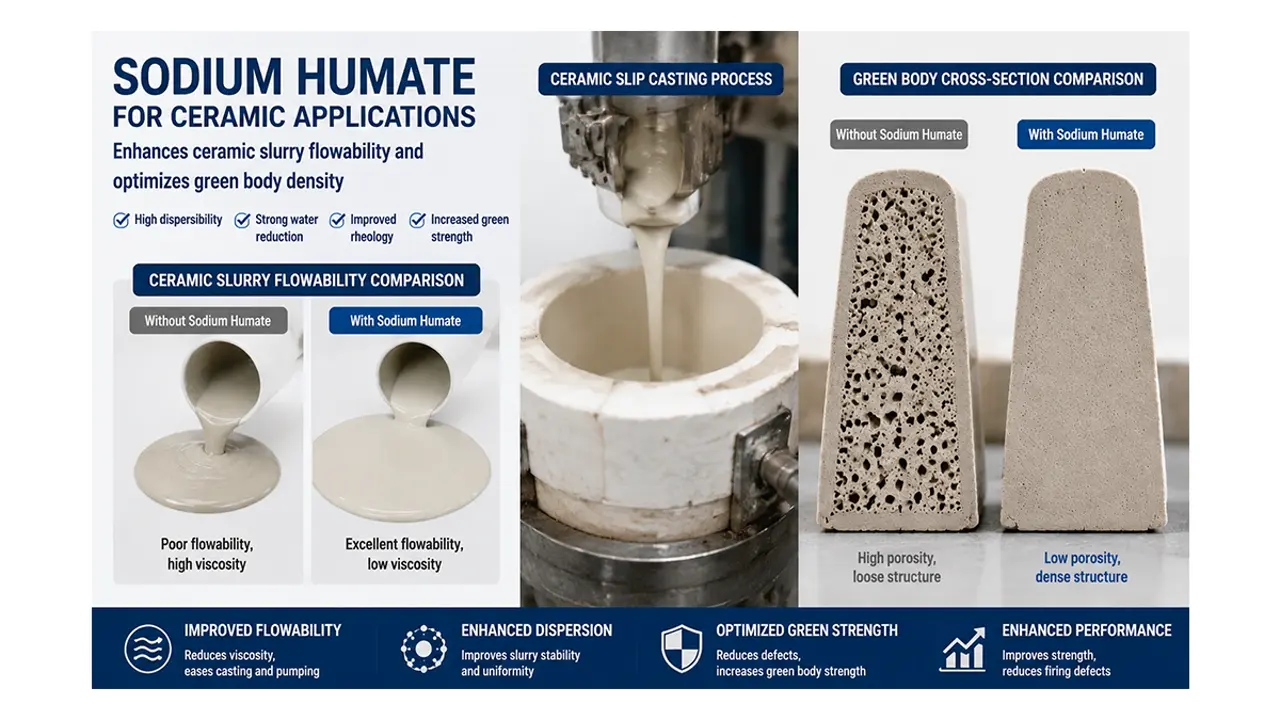
As a natural organic polymer derived from high-quality leonardite, KHUMIC’s sodium humate (HumicFed) provides a science-based solution for professional ceramic manufacturers worldwide.
1. Enhancing Green Strength: Reducing Breakage
The “green strength” of a ceramic body—its strength before firing—is vital for handling, glazing, and transporting the un-fired products.
- Mechanism of Action: Sodium humate acts as a powerful ceramic body binder. Its long-chain organic molecules bridge the gap between clay particles, creating a flexible and strong internal matrix.
- The Result: By adding a small percentage of sodium humate to the mix, manufacturers can increase green strength by 30-50%. This significantly reduces the incidence of cracking and edge damage during the drying and handling phases, leading to a higher yield of finished goods.
2. Optimizing Slurry Fluidity: The Power of Deflocculation
In the production of ceramic tiles and sanitary ware, maintaining a low-viscosity, high-solids slurry is essential for efficient spray drying and slip casting.
- Powerful Dispersant: Sodium humate serves as a highly effective deflocculant. Its anionic functional groups (carboxyl and phenolic hydroxyl) attach to the surface of clay particles, creating a strong negative charge that causes the particles to repel each other.
- Improved Rheology: This repulsion breaks up clusters (flocs) and reduces the viscosity of the slurry. Manufacturers can achieve a more fluid slurry with less water, which reduces energy consumption during the spray-drying process and improves the uniformity of the final ceramic body.
3. Industrial Grade Sodium Humate vs. Agricultural Grade
Not all sodium humate is suitable for ceramic production. KHUMIC’s Industrial Grade Sodium Humate is specifically refined to meet the strict requirements of the ceramic workshop:
- Low Ash Content: Minimizes the introduction of unwanted impurities that could affect the color or firing temperature of the ceramic.
- High Purity & Stability: Ensures consistent performance batch after batch, allowing for precise control over slurry viscosity and body strength.
- Excellent Solubility: Dissolves rapidly in water, ensuring uniform distribution throughout the clay mix.
4. Why Professional Manufacturers Choose KHUMIC
At KHUMIC, we understand that industrial additives must be both high-performing and economically viable. Our HumicFed series is designed to offer:
- Lower Production Costs: By reducing breakage and energy use (in drying), the ROI of using sodium humate is immediate.
- Versatility: Beyond ceramics, our sodium humate is also an ideal additive for petroleum drilling mud (as a fluid loss control agent) and wastewater treatment (as a heavy metal chelator).
- Sustainable Supply: As a source manufacturer, we provide stable, large-scale supply for global industrial operations.
Conclusion: Elevate Your Ceramic Production Standards
Whether you are manufacturing high-end porcelain tiles or mass-produced sanitary ware, Sodium Humate is your secret weapon for quality and efficiency. By investing in a high-purity industrial binder, you are optimizing every step of your manufacturing chain.
Contact KHUMIC today to request technical specifications and samples of our Industrial Grade Sodium Humate and discover the difference in your green strength.

